
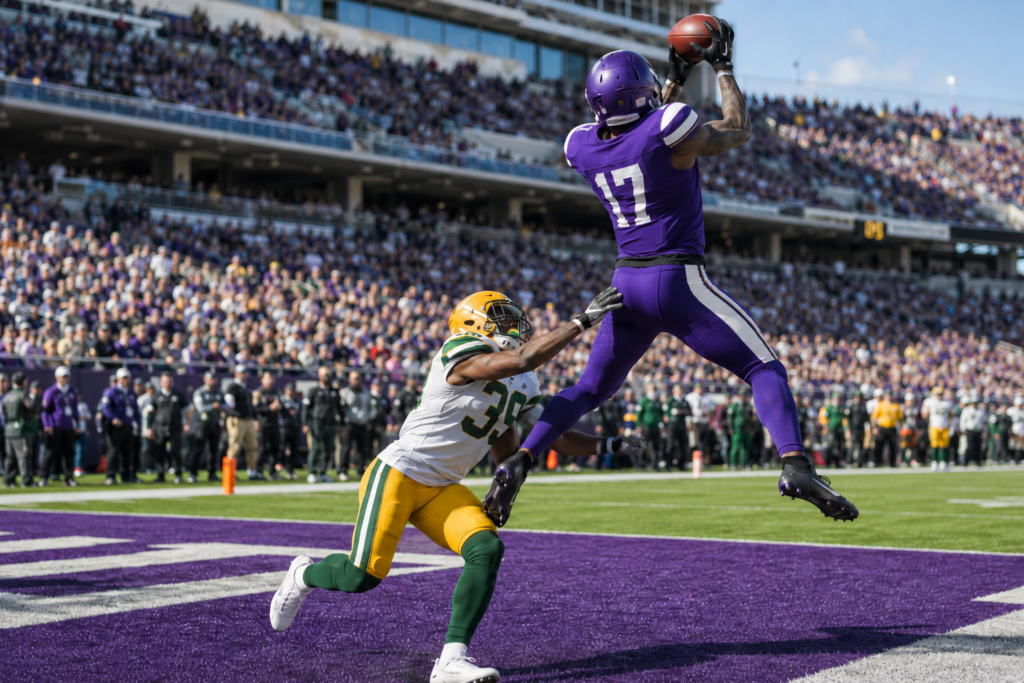
I’ll start with the number that broke my spreadsheet, Justin Jefferson posted the fourth-highest target share in football last year, 31 percent, and finished as the WR22 overall. Per game he was closer to WR30 in PPR and WR41 in non-PPR across all 17 games. You do not see those two data points sitting next to each other. A target share that high almost always drags a top-eight scoring line behind it, and Jefferson averaged 11.9 fantasy points a week. Something in the machine was broken, and it wasn’t the guy running the routes.
What actually cratered was the throwing. Fantasy Life (Dwain McFarland and Ian Hartitz) laid the collapse out plainly in their Vikings cheat sheet: Minnesota’s passing offense went from 277 yards per game in 2023 (first in the league) and 258 in 2024 (fifth) to 189 in 2025, which ranked 30th. That is not a slow decline, that is a passing game falling down the stairs. When the quarterback play collapses that hard, share stops paying out, because you’re taking your cut of nothing. Jefferson kept earning targets at an alpha rate and kept catching passes from one of the least productive throwing operations in the sport. The input survived. The output tracked the QB.
The market watched all of that and slid Jefferson to WR6, overall ADP around 10, drafting him after CeeDee Lamb and just ahead of James Cook. The read is “great player, broken offense, I’d rather take a cleaner situation.” I understand the instinct. I just think it’s pricing the wrong thing, because the broken variable was the quarterback, and the quarterback is the piece Minnesota went out and addressed.
They added Kyler Murray on a one-year deal at the veteran minimum, roughly $1.3 million, with a no-tag clause and every reason to put good tape on film before he hits free agency again next spring. He’s stepping into a Kevin O’Connell offense that put up those 2023 and 2024 passing numbers I just quoted. Now, I’m not going to sell you Murray as some savior. Over his last three seasons he averaged about 220 passing yards a game, which is below league average, and if he plays like that all year this take gets a lot less fun. But 220 with O’Connell scheming it is a big step up from 189 with last year’s room, and the whole case only needs a partial reversion in team passing volume. On a target share that high, even a middle-of-the-pack Vikings passing game puts Jefferson back into top-tier weekly scoring. The consensus already has him projected near 100 catches, 1,300 yards, and 7 touchdowns. I think that’s the modest version of this outcome.
I keep trying to talk myself into one of the safer receivers going around him and I can’t make the math work. You’re paying a low-end WR1 or high WR2 price for a player whose only real problem last year is the exact problem the front office spent the offseason on. He’s 27, he restructured his deal in March to help the cap, he’s locked in as the clear number one, and he closed 2025 by catching eight of eleven for 101 yards against Green Bay in Week 18 to extend his 1,000-yard streak. Even inside the wreckage there were signal games, like the six-catch, 85-yard Week 16 against the Giants. The talent never went anywhere.
At WR6 and pick 10 I’m comfortable clicking him without a second thought. If he slides past pick 13, which happens in rooms that overrate the running back tier, I get aggressive and treat it as a genuine value on an early-second-round profile. I’m taking him at WR 5, before CeeDee Lamb. He fits best in PPR and half-PPR, where his volume floor shows up even in the meh weeks, and he’s a strong best-ball target because the ceiling games pay for the low-QB duds.
The thing that ends this in a hurry is the quarterback. If camp reports have Murray struggling in the offense and leaning towards McCarthy starting instead, the thesis softens and I’d have to recalibrate. So I’m refreshing the Minnesota beat every morning, because Jefferson is the one player on my board I’m both most excited about and most willing to be wrong on.